Amazon Wildlife: A to Z

Animals of the Amazon Rainforest

One forest, one in ten of every species alive. From the jaguar's silent patrol to a frog you could fit on a fingernail, here are the creatures that make the Amazon the loudest, strangest place on Earth.

~1,400
Mammals
~1,500
Birds
2,200+
Fish
1,000+
Amphibians
2.5M
Insect species

Stretching across nine countries and roughly the size of the contiguous United States, the Amazon rainforest is not a single habitat but thousands stacked on top of each other, flooded forest, river channel, dark understory, and a sun-drenched canopy that almost no human ever sees. Each layer runs on its own cast of animals, and most of them you will hear long before you spot them.

This guide is organised the way a naturalist actually moves through the forest: by group. You'll find mammals first, then birds, then the reptiles and amphibians, the fish, and finally the insects and spiders that quietly outnumber everything else. For each species there's its size, what it eats, where it sits in the food web, and its conservation status, plus the one detail that makes it worth remembering. Skip ahead using the A to Z bar below, or read it like a story. If you're curious which of these are also among the planet's most feared, our guide to the world's deadliest animals puts several Amazon species in sharp perspective.

Mammals

the headliners
Jaguar in the Amazon rainforest

Jaguar Panthera onca

Big catApex predatorNear Threatened

The Amazon's top cat doesn't bother chasing prey down, it ambushes, then ends things with the strongest bite of any big cat, punching straight through skull or turtle shell rather than going for the throat. Unlike most cats it loves water, and will happily haul a caiman out of a river. The "black panthers" of legend are simply jaguars carrying a dark coat; look closely in good light and the rosettes are still there. Seeing one in the wild is the rarest prize on any Amazon trip. The jaguar is also one of the most iconic animals that start with J.

Capybara in the Amazon rainforest

Capybara Hydrochoerus hydrochaeris

RodentSemi-aquaticLeast Concern

The world's largest rodent looks like a guinea pig that never stopped growing, up to 65 kg of unbothered calm. Capybaras live in herds at the water's edge and dive in when threatened, able to stay submerged for several minutes. Their relaxed reputation is well earned: birds, monkeys and even small caimans are often photographed sitting on them. To a jaguar or anaconda, though, they are simply lunch.

South American tapir in the Amazon rainforest

South American Tapir Tapirus terrestris

Largest land mammal in S. AmericaVulnerable

Part pig, part horse, with a stubby prehensile trunk for stripping leaves, the tapir is often called a living fossil because its body plan has barely changed in tens of millions of years. It is the heaviest land animal in the Amazon, yet it moves like a shadow, following the same worn trails to water each night. As it wanders it swallows and scatters huge quantities of seeds, making it one of the forest's most important gardeners.

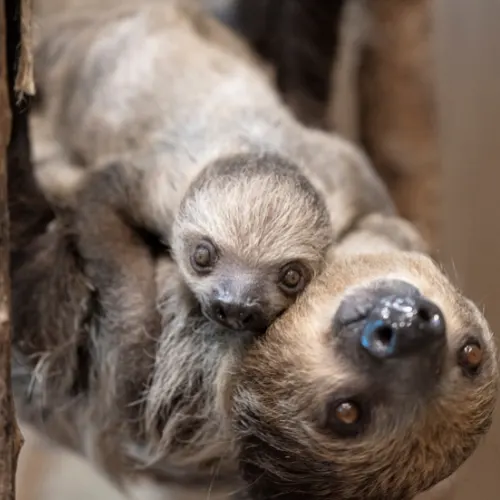
Sloth hanging in Amazon rainforest tree

Sloth Bradypus & Choloepus spp.

ArborealLeast Concern

A sloth is so slow that algae grows in its fur, turning it green and hiding it in plain sight among the leaves. That sluggishness is a strategy, not a flaw: by digesting leaves over weeks and barely moving, it survives on a diet almost nothing else could. It descends from the canopy only about once a week, to defecate, which is, statistically, the most dangerous moment of its life.

Giant river otter in the Amazon

Giant River Otter Pteronura brasiliensis

Largest otterPack hunterEndangered

Reaching nearly 1.8 metres, this is the longest otter on Earth and one of the Amazon's noisiest residents, families of up to twenty patrol their stretch of river with a constant chatter of screams and hums. They hunt fish in coordinated packs and have been recorded driving off caimans together. Decades of hunting for their velvet pelts pushed them to the brink, and they remain endangered today.

Amazon river dolphin in the Amazon river

Amazon River Dolphin Inia geoffrensis

Freshwater dolphinEndangered

The "boto" is the largest river dolphin in the world and, oddly, turns pink with age, the males more so, their colour deepening with every scar from sparring. An unfused neck lets it turn its head almost ninety degrees to weave between flooded tree roots after fish. Riverside communities have told stories for centuries of botos that step ashore at night as charming strangers, a folklore that has helped protect them.

Howler monkey in the Amazon rainforest

Howler Monkey Alouatta spp.

PrimateLeast Concern

The loudest land animal in the Americas, a howler's dawn roar carries up to five kilometres through the trees, a sound somewhere between a gale and a distant jet engine. A hollow, enlarged throat bone acts as a megaphone. They put almost all of that energy into shouting and very little into moving, dozing for fifteen hours a day on a low-octane diet of leaves.

Capuchin monkey in the Amazon rainforest

Capuchin Monkey Cebus & Sapajus spp.

PrimateTool userLeast Concern

Pound for pound one of the smartest animals in the forest. Capuchins use stone "hammers" to crack palm nuts, rub crushed millipedes into their fur as insect repellent, and pass these tricks down through generations, culture, in other words. Their cleverness is exactly why they were the monkeys Hollywood kept casting, and exactly why they make miserable pets.

Pygmy marmoset smallest monkey in Amazon

Pygmy Marmoset Cebuella pygmaea

Smallest monkeyLeast Concern

The smallest monkey on Earth weighs about as much as a stick of butter and fits in a cupped hand. It survives by gnawing neat holes in tree bark and lapping up the sap that wells out, returning to its "taps" again and again. Surrounded by predators, the whole family will sometimes freeze stone-still until danger passes.

Giant anteater in the Amazon rainforest

Giant Anteater Myrmecophaga tridactyla

InsectivoreVulnerable

It has no teeth at all. Instead it rips open a termite mound with bear-like claws and flicks a 60-centimetre, glue-coated tongue in and out up to 150 times a minute, hoovering as many as 30,000 insects a day. It rarely lingers, taking a fraction from each nest so the colony recovers and the buffet stays open. Cornered, it rears up and slashes; those claws have killed jaguars.

Ocelot wild cat in the Amazon rainforest

Ocelot Leopardus pardalis

Small catLeast Concern

A cat the size of a small dog, dressed in a coat so beautiful it was nearly hunted out of existence in the twentieth century. The ocelot owns the night, hunting rodents and reptiles across a fiercely defended territory and resting in the trees by day. It has recovered well where the forest still stands.

Kinkajou in the Amazon rainforest

Kinkajou Potos flavus

NocturnalLeast Concern

Often mistaken for a monkey, the kinkajou is actually a relative of the raccoon. It spends its entire life in the canopy, gripping branches with a prehensile tail and licking nectar from flowers with a freakishly long tongue, which quietly makes it one of the rainforest's pollinators. Locals call it the "honey bear" for its love of sweet things.

Birds

the canopy's colour
Harpy eagle perched in Amazon rainforest

Harpy Eagle Harpia harpyja

Apex raptorVulnerable

The most powerful eagle on the planet, with rear talons longer than a grizzly bear's claws, easily long enough to snatch a full-grown sloth or monkey out of the treetops. Rather than soar above the forest, it hunts beneath the canopy, slipping between branches with terrifying control. A pair raises a single chick only every two to three years, which is part of why losing even one bird matters so much.

Toco toucan in the Amazon rainforest

Toco Toucan Ramphastos toco

Largest toucanLeast Concern

That enormous orange bill, nearly half the bird's length, looks like a weapon but is honeycombed with air, lighter than it appears. It works as a fruit-grabbing tool and, remarkably, as a radiator: the toucan dumps body heat through it, dialling the blood flow up and down to stay cool. They hop more than they fly, croaking through the canopy like a chorus of frogs.

Hyacinth macaw in the Amazon rainforest

Hyacinth Macaw Anodorhynchus hyacinthinus

Largest flying parrotVulnerable

A metre of cobalt-blue parrot with a beak strong enough to crack open palm nuts that would defeat a pair of pliers. Hyacinths mate for life and are fussy nesters, relying on the holes of just a few old tree species, which makes them painfully vulnerable to logging and the pet trade. Where they pass nuts through undigested, they help plant the next generation of forest.

Scarlet macaw flying in Amazon rainforest

Scarlet Macaw Ara macao

ParrotLeast Concern

Loud, gaudy and unmistakable, scarlet macaws stream across the sky in pairs and small flocks at dawn. They gather by the dozen at riverbank "clay licks," eating mineral-rich mud that is thought to neutralise toxins in their seed-heavy diet. Like other macaws they're long-lived and intelligent, with the vocal mimicry to match.

Hoatzin bird in the Amazon rainforest

Hoatzin Opisthocomus hoazin

"Stinkbird"Least Concern

One of the strangest birds alive. The hoatzin ferments leaves in an oversized crop the way a cow does in its gut, earning it the nickname "stinkbird", and its chicks are born with working claws on their wings, scrambling through branches and even diving into water to escape danger before losing the claws as they grow. It is a living puzzle that scientists still can't neatly place on the bird family tree.

Andean cock-of-the-rock in Amazon rainforest

Andean Cock-of-the-rock Rupicola peruvianus

Cloud forestLeast Concern

The males are a shocking, almost neon orange, with a disc-shaped crest that all but hides the beak. They gather at communal display grounds called leks, bobbing, bowing and squabbling while the drab brown females stroll through and pick a partner. Found along the forested Andean foothills of the western Amazon, it is Peru's national bird.

Reptiles & Amphibians

the cold-blooded majority
Green anaconda in the Amazon rainforest

Green Anaconda Eunectes murinus

Heaviest snakeNot threatened

The heaviest snake on Earth, a big female can pass 5 metres and weigh as much as a grown man, with reports of larger. It is not venomous; it is a constrictor that lies half-submerged in slow water, seizes prey, and squeezes until the heart stops. Females dwarf males, and during the breeding season a dozen or more suitors may tangle around a single one in a slow-motion "breeding ball."

Black caiman in Amazon river waters

Black Caiman Melanosuchus niger

Largest Amazon predatorRecovering

At up to 5 metres, the black caiman is the apex predator of the Amazon's waterways, the only animal that routinely preys on adult anacondas, giant otters and capybaras. Its dark, armoured hide once made it a prime target for the skin trade, which gutted populations through the twentieth century, but protection has allowed a steady comeback. After dark its eyes glow red in a torch beam.

Emerald tree boa coiled in Amazon rainforest

Emerald Tree Boa Corallus caninus

Arboreal constrictorLeast Concern

Coiled in tidy loops over a branch, this vivid green snake is almost invisible against the leaves. It hunts by night, hanging down and striking with some of the longest teeth, relative to head size, of any non-venomous snake, perfect for hooking birds out of the air. Heat-sensing pits along its lips let it "see" warm prey in total darkness.

Poison dart frog in the Amazon rainforest

Poison Dart Frog Dendrobatidae

AmphibianToxicSome Endangered

Their dazzling colours are a warning, not a disguise. The golden poison frog carries enough toxin in its skin to kill several adults, a poison some Indigenous groups have used to tip blow-darts. The twist: the frogs aren't born poisonous, they build their defence from the insects they eat, so captive-raised individuals are completely harmless. Devoted parents, the adults ferry their tadpoles up into water-filled bromeliads in the canopy.

Glass frog on leaf in Amazon rainforest

Glass Frog Centrolenidae

AmphibianVaries

Turn one over and you can watch its heart beat, the skin on its belly is so transparent the organs show through. Recent research found that some glass frogs hide their red blood cells in the liver while they sleep, turning nearly see-through to vanish from hungry eyes. They are tiny, no bigger than a fingertip, and the males stand guard over their eggs on leaves above the streams.

Green iguana in the Amazon rainforest

Green Iguana Iguana iguana

LizardLeast Concern

A large, mostly vegetarian lizard that can reach two metres nose to tail and lives high in the riverside trees. Its escape plan is dramatic: when a hawk closes in, the iguana simply lets go and free-falls into the water below, swimming off unharmed. It even has a pale "third eye" on top of its head that detects shadows from above.

Fish

life beneath the surface
Arapaima pirarucu giant fish in Amazon river

Arapaima (Pirarucu) Arapaima gigas

One of the largest freshwater fishData Deficient

A giant of the rivers, the arapaima can reach three metres and is one of the largest scaled freshwater fish in the world. Strangest of all, it breathes air: it must surface every ten to twenty minutes to gulp from the atmosphere, a habit that lets it survive in stagnant, oxygen-poor pools, and unfortunately makes it easy for fishers to find. Its scales are so tough they've been studied as a model for body armour.

Red-bellied piranha in the Amazon river

Red-bellied Piranha Pygocentrus nattereri

Predatory fishLeast Concern

The piranha's reputation for stripping a cow to bone in minutes is mostly Hollywood. In reality they are nervous, mostly scavenging fish that shoal in large numbers for safety, not for hunting people. They do bite, those interlocking teeth shear flesh cleanly, and they "talk," producing low croaks and drumming sounds with their swim bladder when agitated.

Electric eel in the Amazon river

Electric Eel Electrophorus electricus

Not a true eelLeast Concern

Not actually an eel but a knifefish, this two-metre animal can deliver a jolt of up to 600 volts, enough to stun a horse, from cells stacked like the batteries they helped inspire. It uses weak pulses to navigate and find prey in murky water, then ramps up to a high-voltage strike to paralyse fish. Some have even been filmed leaping out of the water to zap a threat directly.

Amazonian manatee in the Amazon river

Amazonian Manatee Trichechus inunguis

Aquatic mammalVulnerable

The only manatee that lives entirely in fresh water, this gentle giant grazes on floating plants and can put away tens of kilos of greenery a day. It is shy and rarely seen, surfacing just enough to breathe before sinking back into the tannin-stained water. Hunting and habitat loss have left it vulnerable across its range.

Insects & Arachnids

the true rulers
Bullet ant in the Amazon rainforest

Bullet Ant Paraponera clavata

Most painful stingLeast Concern

Its sting tops the scientific pain index, described as like being shot, a searing, throbbing agony that can last a full day. Among the Sateré-Mawé people of Brazil, boys mark their coming of age by wearing gloves woven full of these ants, enduring the stings without flinching. For an animal barely three centimetres long, it commands extraordinary respect.

Goliath birdeater tarantula in Amazon rainforest

Goliath Birdeater Theraphosa blondi

Largest spider by massLeast Concern

With a leg span the width of a dinner plate, this is the heaviest spider on Earth. Despite the name it rarely eats birds, preferring worms and large insects. Its real defences are theatrical: it rubs its legs together to make a hissing rasp you can hear across a clearing, and flicks barbed hairs that irritate skin and eyes. The bite hurts, but the venom is mild.

Blue morpho butterfly in the Amazon rainforest

Blue Morpho Butterfly Morpho spp.

IridescentLeast Concern

That electric blue isn't pigment at all, there's no blue dye in the wing. Microscopic ridges bend light to create the colour, the same trick of physics now used in forgery-proof banknotes and energy-saving screens. The undersides are dull brown with eye-spots, so a morpho seems to blink in and out of existence as it flaps through a sunbeam.

Leafcutter ant carrying leaf in Amazon rainforest

Leafcutter Ant Atta & Acromyrmex spp.

FarmerLeast Concern

Watch a green river of leaf fragments flowing across the forest floor and you're watching agriculture older than humanity. Leafcutters don't eat the leaves, they carry them underground to feed a fungus, and it's the fungus they farm and eat. A single colony can number in the millions, organised into castes from tiny gardeners to soldiers, all serving one egg-laying queen.

Quick-facts comparison, at a glance
AnimalGroupSize / WeightDietStatus
JaguarMammalUp to 100 kgCarnivoreNear Threatened
CapybaraMammalUp to 65 kgHerbivoreLeast Concern
South American TapirMammalUp to 250 kgHerbivoreVulnerable
Giant River OtterMammalUp to 1.8 mFishEndangered
Amazon River DolphinMammalUp to 2.5 mFishEndangered
Harpy EagleBird2 m wingspanCarnivoreVulnerable
Hyacinth MacawBird~1 m longNuts, seedsVulnerable
Green AnacondaReptile5 m+ / heaviest snakeCarnivoreNot threatened
Black CaimanReptileUp to 5 mCarnivoreRecovering
Poison Dart FrogAmphibian2-6 cmInsectivoreSome Endangered
ArapaimaFishUp to 3 mCarnivoreData Deficient
Electric EelFishUp to 2 mCarnivoreLeast Concern
Bullet AntInsect~3 cmNectar, preyLeast Concern
Goliath BirdeaterArachnid30 cm leg spanCarnivoreLeast Concern

Jungle animals vs Amazon animals, what's the difference?

People often search for a "list of jungle animals" and an "Amazon animals list" as if they're the same thing, but there's a real distinction worth knowing. Jungle animals is a catch-all term for the wildlife of dense tropical forests anywhere on Earth, which is why a typical jungle animals list mixes in tigers, gorillas, orangutans and elephants from Asia and Africa.

Amazon rainforest animals are far more specific: only the species native to the Amazon basin of South America. You'll never meet a wild tiger or gorilla here. Instead the Amazon's signature cast is the jaguar, the capybara, the pink river dolphin, the harpy eagle and the poison dart frog, animals found in this one corner of the planet and almost nowhere else. Every species on this page is a true Amazon native.

Frequently asked questions

How many animal species live in the Amazon rainforest?

The Amazon is the most biodiverse place on Earth, home to roughly one in ten of all known species. That works out to around 1,400 mammals, 1,500 birds, 2,200 fish, more than 1,000 amphibians, and an estimated 2.5 million species of insect, and new ones are described almost every week.

What is the most dangerous animal in the Amazon?

Not the one you'd guess. The deadliest animal to humans is the mosquito, which spreads malaria and other diseases. Among the larger wildlife, the black caiman, green anaconda, bullet ant and poison dart frog deserve the most caution, though attacks on people are genuinely rare, and most Amazon animals want nothing to do with you.

What is the largest animal in the Amazon rainforest?

It depends where you look. On land, the South American tapir is the heaviest mammal. In the rivers, the Amazonian manatee and the giant arapaima are the largest, and the green anaconda is the heaviest snake on the planet. In the air, the harpy eagle is the forest's most powerful bird.

What animals are unique to the Amazon and found nowhere else?

Many. The pink Amazon river dolphin, the giant otter, the hoatzin "stinkbird," several poison dart frogs and the Amazonian manatee are all endemic or near-endemic to the Amazon basin, meaning they exist here and almost nowhere else in the wild.

The full A to Z of Amazon animals

A quick alphabetical reference, the species above plus other notable Amazon residents.

AAgouti, Anaconda, Anteater, Arapaima, Armadillo
BBlack caiman, Blue morpho, Boa constrictor, Bullet ant
CCapybara, Capuchin, Caiman, Coati, Cock-of-the-rock
DPink river dolphin, Poison dart frog
EElectric eel, Emerald tree boa, Emperor tamarin
FFer-de-lance, Firefly
GGiant otter, Giant anteater, Glass frog, Goliath birdeater
HHarpy eagle, Hoatzin, Howler monkey, Hummingbird
IIguana (green)
JJaguar, Jesus lizard (basilisk)
KKinkajou, Kingfisher
LLeafcutter ant, Leguana, Llama (Andes)
MMacaw, Manatee, Margay, Marmoset
NNight monkey
OOcelot, Opossum, Otter
PPiranha, Puma, Pygmy marmoset, Peccary
QQuetzal (cloud forest)
RRed-bellied piranha, Red brocket deer
SSloth, Scarlet macaw, Spider monkey, Scorpion
TTapir, Toco toucan, Tamarin, Tarantula
UUakari monkey
VVampire bat, Vulture (king)
WWoolly monkey, Wandering spider
XXenops (bird)
YYellow-footed tortoise
ZZigzag heron
Scroll to Top